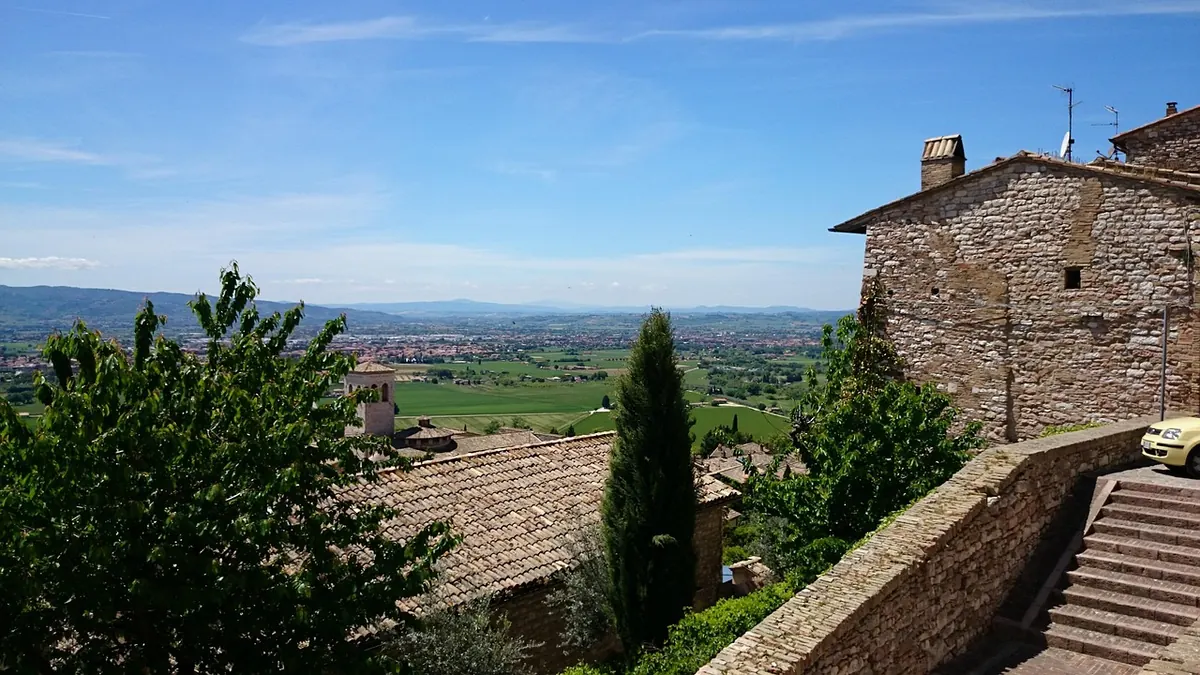
The light comes in low through the barn door in late afternoon, and suddenly the faded panel above it looks grey rather than blue. Dust has settled into the plaster, soot from the stove has crept across the arch, and a cobweb hangs from a painted hand. The bucket and sponge are already in your own hand before you have thought about it. Stop there. A countryside fresco is one of the few things in a farmhouse that can be ruined permanently in under a minute by a person trying to help it. The real question is not whether the wall needs attention. It is which kind of attention, applied by whom, and in what order.
Fresco is not one material. True fresco is pigment locked into lime plaster while the plaster is still setting; the lime carbonates and the colour becomes part of the wall. It is alkaline and reasonably tolerant of careful, controlled moisture. But many country walls carry a second layer of work: fresco secco touches, tempera details, glazes bound with egg, glue or casein, added after the plaster dried so the painter could get a stronger blue or a sharper fold of cloth. Those layers are water-sensitive. A damp cloth that is harmless on the lime can lift a red border straight onto the sponge.
Then there is everything on top of the painting rather than in it: whitewash applied by a later owner, nineteenth-century overpainting, a lime wash skim. And there is what has landed on the surface over a century or two — household dust, soot from a wood stove or open fire, candle smoke, fly specks, cobwebs, insect nests, the greasy film that drifts out of a working kitchen.
Before touching anything, look closely and take photographs. Note hairline cracks, tide marks, a powdery white bloom on the surface, flakes standing slightly proud. Tap the plaster very gently with a knuckle in a few places. A hollow sound means the plaster has separated from the wall behind, and that changes every calculation. If you see soft, crumbling plaster or a salty bloom, stop and bring in a conservator.
Most of the grey veil on a country fresco is loose material sitting on the surface, and dry cleaning removes it with almost no risk. The kit is modest: soft brushes of goat or badger hair, a conservation vacuum on low suction, a piece of muslin stretched over the nozzle so nothing is scraped, and clean cotton cloths. Work from the top down, one small area at a time, and let the brush do the work rather than your wrist. Never press, never scrub in circles.
For soot — the fine, greasy grey film that settles on walls above a stove — conservators sometimes use vulcanised rubber sponges, often called chemical sponges. They work by lifting rather than dissolving, but they can leave a residue and they must be dabbed, not rubbed, and replaced as soon as the face clogs with dirt. Aim to remove what comes away easily and then stop. Dry cleaning is reversible, gentle and honest: it takes away the dust and leaves the painted surface exactly as it was.
On a barn wall or a small chapel used a few times a year, dry cleaning plus control of the source of the dirt is often the whole treatment. Nothing more is needed, and nothing more should be attempted.
Water is a solvent, and that is the problem. It dissolves salts in the plaster and draws them towards the surface, where they crystallise and push paint off. It swells the lime, softens fragile secco layers and can carry soot deeper into porous plaster rather than lifting it out. Used carelessly, it leaves a tidemark that is harder to remove than the original grime.
None of which means wet cleaning is wrong. It means the variables decide everything. A trained restorer will test in an inconspicuous corner, then work with deionised water rather than tap water, with cotton swabs or Japanese tissue, sometimes with a gel that holds the moisture in place instead of letting it sink into the wall, sometimes with a chelating agent for a stubborn gypsum crust. Salts are pulled out with poultices over days, not scrubbed off in an afternoon. The method is chosen for the specific wall, not borrowed from a cleaning cupboard.
The third approach is less a technique than a discipline. Its argument is that the wall you are looking at is a document, and that every intervention removes evidence as well as dirt. It says: stabilise what is failing, remove what is actively harmful, then leave the surface alone.
In practice that often means the work happens ten metres away from the painting. A leaking gutter is cleared and rehung. A cracked roof tile is replaced. Groundwater is led away from the footing, a blocked vent is opened, and a room that has been sealed shut for decades is allowed to breathe again. Damp and salts do far more damage to country frescoes than dust ever will, and no amount of gentle brushing will fix a wall that is quietly soaking up moisture from below.
Minimal intervention also means accepting a readable, aged surface. The pale patch where a beam once sat, the soft abrasion across a saint's robe, the section lost to a Victorian doorway: these are part of the wall's history. Many owners find that once the dust and soot are gone, the remaining wear is far less bothersome than they expected.
Most of the damage seen on rural frescoes was not caused by neglect. It was caused by well-meant cleaning. The common failures look like this:
There is also the authorisation question. In Italy, painted surfaces of historic interest are generally protected, and cleaning work on them normally requires permission and a qualified restorer. That is not bureaucracy for its own sake; it is the reason the same wall can be looked at twice in fifty years instead of once.
You can do a great deal without ever touching the paint. Start by recording: photographs from the same spot each year, with a note of date, weather and anything that has changed. Deal with water first — gutters, downpipes, roof, drainage, the ground level outside the wall. Keep the room ventilated rather than heated hard, and avoid pushing warm, moist air from a kitchen or bathroom against a cold painted wall. Dust lightly with a soft brush once a year if loose dust is building up. Do not seal, varnish, wax or "feed" the plaster with oil or linseed. Do not point a pressure washer, a steam cleaner or a household anti-mould spray anywhere near it.
Then get one proper assessment. A conservator will tell you whether the wall is stable, whether salts or moisture are active, and whether dry cleaning alone would make a real difference. Sometimes the answer will be that the fresco is fine as it is and should be left quiet. Often that is the best outcome of all — a wall that keeps its history, its softness and its colour, with nobody's good intentions smeared across it.
Photo: ChiemSeherin / Pixabay